Spray drying is widely used across pharmaceutical, food, and process industries, where product quality and process performance depend on complex interactions between gas flow, heat transfer, solvent evaporation, particle trajectories, and drying behaviour.
Computational Fluid Dynamics (CFD) provides detailed insight into these phenomena, but high-fidelity simulations can require significant computational time. PhysicsAI offers the potential to learn from validated CFD simulations and predict engineering fields in seconds or minutes, enabling much faster exploration of operating conditions.
At Intelimek, we are evaluating this approach progressively across important spray-drying parameters and KPIs. Temperature field was selected as the first prediction target because temperature directly influences drying behaviour and provides a fundamental indicator of the thermal environment experienced by particles inside the dryer. Other parameters and KPIs, including residence time and drying-related quantities, can subsequently be incorporated into the same framework.
However, rapid prediction alone is not sufficient for an engineering application. Two questions become equally important:
How closely can the PhysicsAI model reproduce the complete CFD temperature field within the operating range used for model development? And what happens to prediction accuracy when the model is applied outside that range?
This study explores both questions using a PhysicsAI model developed from validated CFD simulations of a spray dryer.
Model Validation
The PhysicsAI model was validated against CFD using a stringent cell-by-cell comparison across the complete CFD mesh. Rather than comparing average or outlet temperatures, selected monitoring locations, or overall trends, the PhysicsAI-predicted temperature at every computational cell was compared directly with the corresponding CFD-predicted temperature.
For each cell, the prediction error was calculated as:
Cell-level error (%) = |PhysicsAI prediction − CFD prediction| / CFD prediction × 100
For a temperature field containing thousands of computational cells, this provides a rigorous measure of the model's ability to reproduce local temperature variations across the complete spatial field. The resulting error field is visualized using error contours, showing not only the magnitude of prediction error but also where within the spray dryer deviations from the CFD solution occur.
Across the evaluated cases within the design space, the maximum cell-level error remained below 5%, demonstrating close agreement between the PhysicsAI and CFD temperature fields. Generating the same temperature field through CFD requires several hours of simulation time, whereas the trained PhysicsAI model generates the complete field in less than 2 minutes.
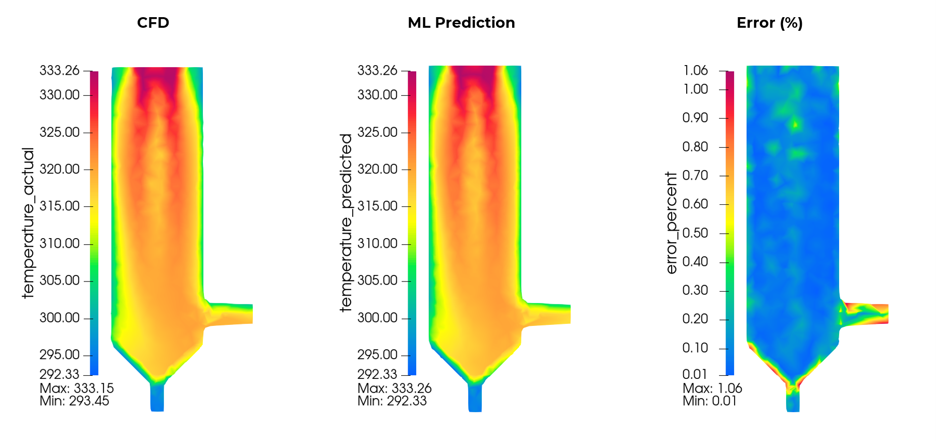
Figure 2. Comparison of CFD-predicted and ML-predicted temperature fields, along with the corresponding error contour, for a representative operating condition within the training design space.
The model was then evaluated at different operating conditions within and progressively outside the training design space. The error contours below show the cell-level difference between the PhysicsAI prediction and the corresponding CFD solution across the complete field.
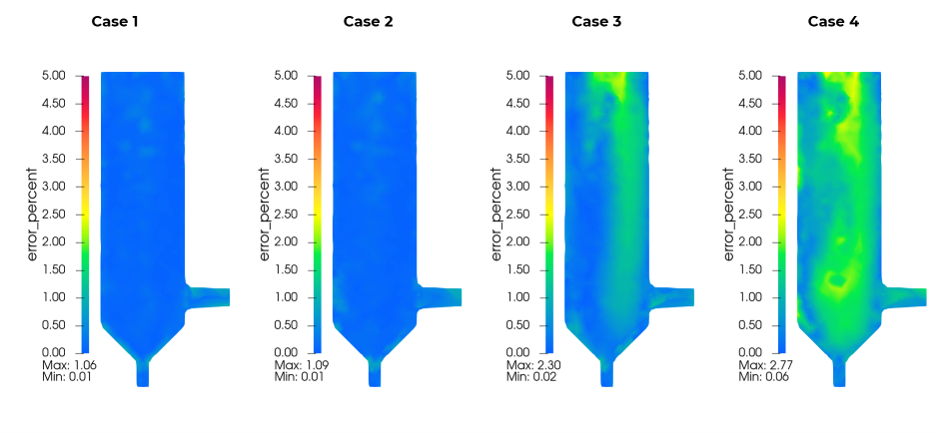
Figure 3. Model accuracy assessment at multiple operating conditions within the training design space.
Cases 1–3 represent conditions within the design space and show consistently low prediction errors. Case 4 is marginally outside the design space and still provides a reasonably acceptable prediction. These results indicate that the model maintains good predictive performance within the trained operating envelope and close to its boundary.
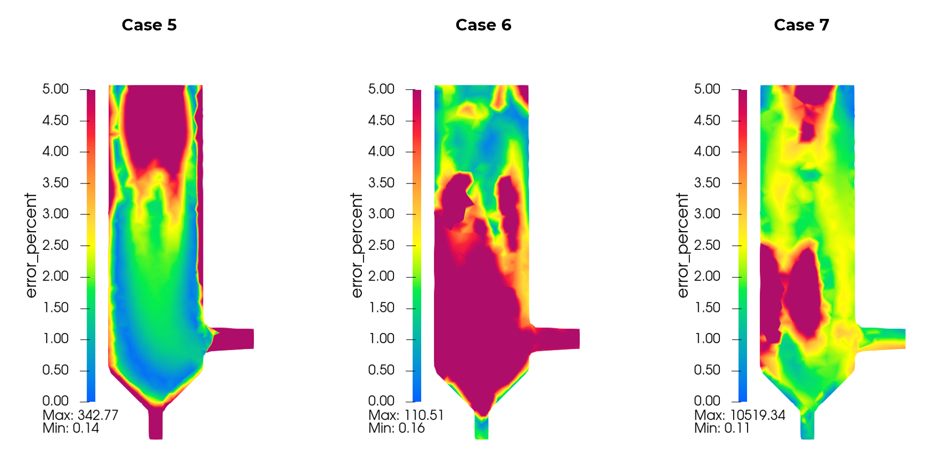
Figure 4. Model performance within and outside the training design space. Cell-level prediction errors remain low within the design space and close to its boundary, but progressively increase as operating conditions move further away from the training envelope.
As operating conditions move further away from the training range, the prediction error progressively increases, as observed in Cases 5–7.
The overall behaviour can be summarized as follows:
| Evaluation Region | Validation Method | Observed Error | Interpretation |
|---|---|---|---|
| Within design range | Cell-by-cell comparison across the complete CFD mesh | Maximum cell-level error <5% | PhysicsAI closely reproduces the CFD temperature field |
| Outside design range | Same cell-by-cell comparison against CFD | Maximum cell-level error >5%* | Prediction error increases as conditions move beyond the training range |
This behaviour is consistent with machine-learning models and highlights the importance of defining an appropriate design space during model development. From a practical deployment perspective, PhysicsAI provides rapid, high-fidelity predictions within a validated operating envelope. When substantially different operating conditions need to be explored, additional CFD simulations can be used to extend the training design space and retrain the model.
PhysicsAI therefore complements CFD: CFD establishes and extends the validated operating envelope, while PhysicsAI enables rapid prediction and exploration within that envelope.
Takeaways
 PhysicsAI enables rapid
prediction of complete temperature fields. The trained model generates the
temperature field in less than 2 minutes, compared with several hours for CFD.
PhysicsAI enables rapid
prediction of complete temperature fields. The trained model generates the
temperature field in less than 2 minutes, compared with several hours for CFD.- Validation is performed at
the CFD cell level. PhysicsAI predictions are compared directly with CFD at
every computational cell, providing a stringent assessment of local temperature-field
accuracy rather than relying on averages or overall trends.
- High prediction accuracy is
achieved within the training design space. Across the evaluated cases, the
maximum cell-level error remained below 5%.
- Prediction accuracy
gradually decreases outside the training range. Accuracy remains reasonably
acceptable close to the design-space boundary but degrades as operating conditions move
further away from the training envelope.
- PhysicsAI complements CFD
rather than replacing it. CFD establishes and extends the validated
operating envelope, while PhysicsAI enables rapid prediction and exploration within that
envelope.
- Temperature field
prediction is the first step. The same PhysicsAI approach can be
progressively extended to additional spray-drying parameters and KPIs, such as particle
residence time and drying behaviour.
- InteliSIM separates model development from model consumption. AI specialists can develop, validate, and manage models, while process engineers can use validated PhysicsAI models without requiring AI programming expertise.
This series will progressively explore PhysicsAI prediction of additional spray-drying parameters and KPIs, including temperature fields, particle residence time, solvent concentration, and drying behaviour, followed by their integration into practitioner-facing applications using InteliSIM.