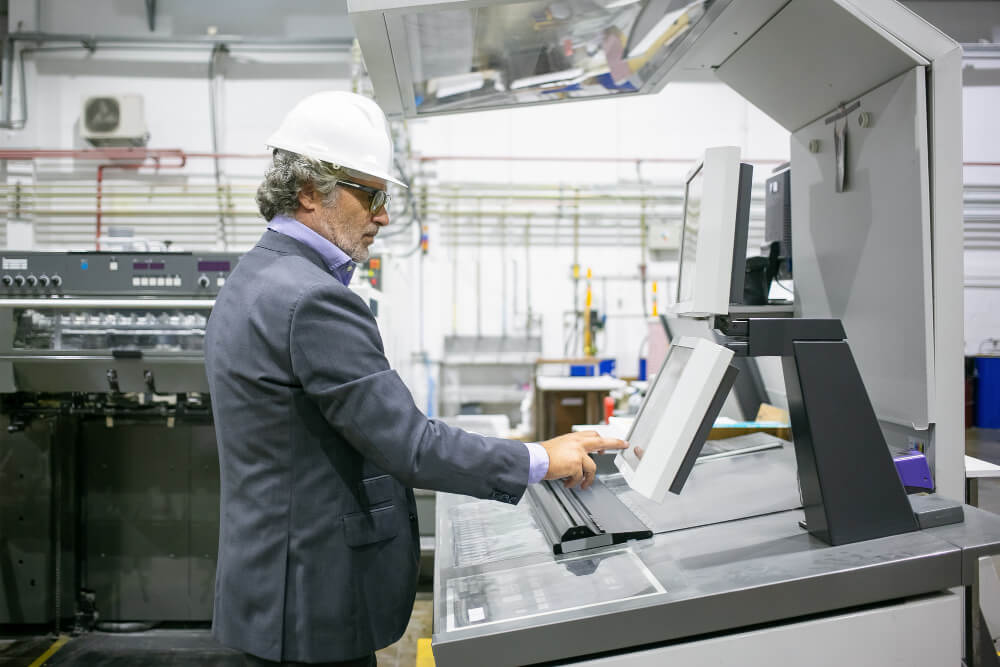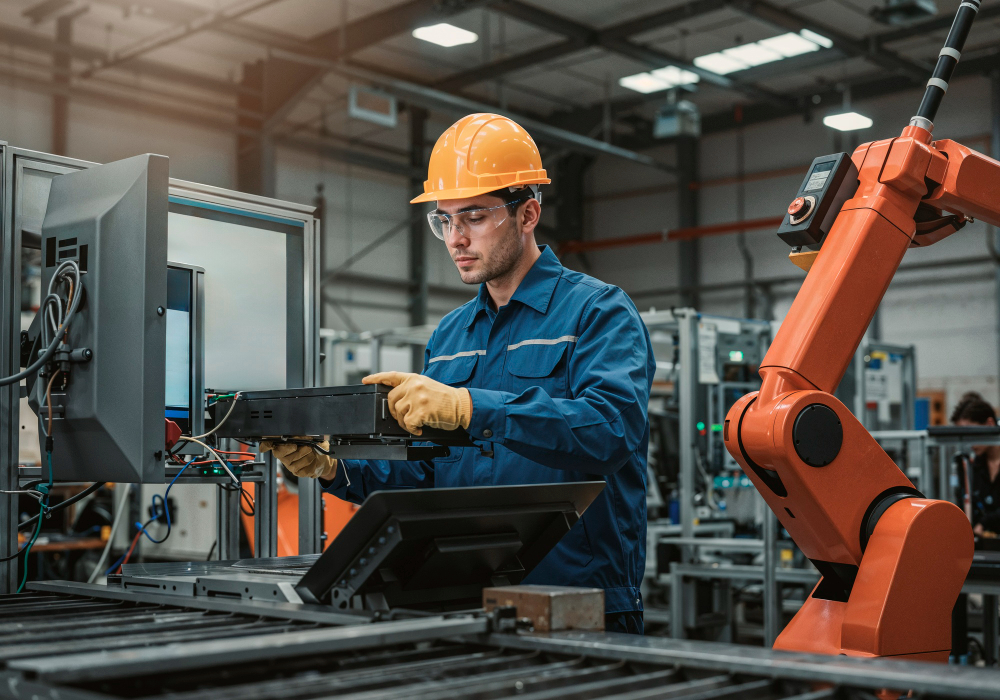
The engineer's role in human-centric, physics-informed AI, and how people and AI complement each other in manufacturing
AI in manufacturing is inevitable, and it is redefining the role of people. That raises a
fundamental question: who makes the call, and who owns the responsibility for the decision?
Engineers trust AI when they can understand why
it says what it says. Without that, even an
accurate model gets ignored.
Most manufacturing engineers are trained to think in cause and effect. Machines and
processes, from gears and heat flow to mixing, spray drying, coating and compaction, behave
according to the laws of physics, and that's how engineers reason about them. A
manufacturing engineer once summed it up for us: "We just know zero and one." A part passes
or it fails. A prediction that says a batch is "75% likely to be good" doesn't help the
person who has to sign it off.
Statistical models are widely used by the scientific community and in many other areas, such
as weather forecasting and financial planning. But a good fit and a high accuracy score
still don't tell an engineer why a model predicts what it does. With modern AI, models get
more powerful and more opaque, and that question gets bigger.
We've seen what happens when this question goes unanswered. On one predictive maintenance
project, vibration sensors on the electric motor of a forging machine raised repeated alerts
while the equipment kept running normally. Over time, the alerts were ignored. Then one day
the motor shaft broke, even though the model had flagged it. The problem was the engineers'
lack of trust in the model, and no clarity about the engineer's role alongside it. Trust in
AI comes from involving engineers in the process and defining clear roles for both the AI
and the engineer.
Should we fear AI the way sci-fi movies portray it?

Films have given us plenty of robots that turn on their makers, but the serious global conversation is about how people and AI work together. Governments, researchers and industry are building toward AI that supports people rather than replacing them:
 Europe: The European Commission's Industry
5.0 vision makes human-centricity one of
three pillars of future industry, alongside sustainability and resilience. It
describes
technology that supports and empowers workers rather than replacing them, and the
Commission has published a human-centric roadmap for manufacturing.
- Japan: The government's Society 5.0 vision,
set out in 2016, describes a human-centered
society built on close integration of the physical and digital worlds.
- United States: NIST's AI Risk Management
Framework focuses on building trustworthiness
into how AI is designed, developed and used. Stanford's Institute for Human-Centered
AI
holds that AI should be designed to "augment, not replace, people."
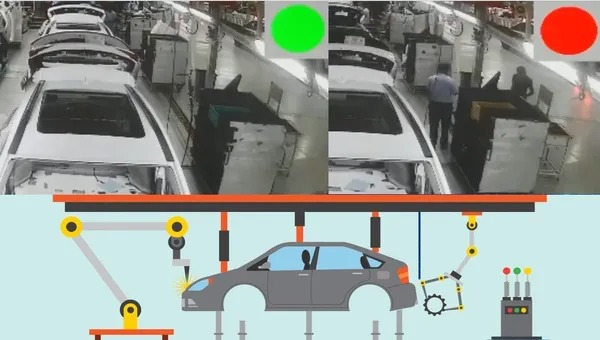
Human-centric AI succeeds when people are ready to embrace it and expectations are clear from the start.
Keeping people in control is an engineering requirement
Keeping people at the center of AI has an
important human and social side. But it is more
than that. It is also an engineering requirement.
If AI does everything, people lose skills, work and purpose. But in manufacturing there is a
more practical reason: reliability and accountability depend on keeping people
involved.
Accountability. An AI model may be more accurate or more powerful than a
person at certain
tasks. But when something goes wrong in the process, someone has to answer for it. You can't
hold a person accountable for a decision they weren't part of, and you can't hold an AI
accountable at all. In regulated industries such as food and pharmaceuticals, where a
responsible person must approve every batch release, this accountability is not
optional.
Regulators are making this explicit. The European Commission's draft Annex 22 to the EU GMP
guidelines, which covers AI in medicines manufacturing, includes a section on
human-in-the-loop and calls for continuous oversight of AI systems, including performance
monitoring and procedures for human review.
Risk assessment. One of an engineer's most important jobs is weighing
what-if scenarios.
With every design change or operating decision, engineers assess risk, often implicitly: the
impact on quality, cost, safety and downtime. Real plants face many sources of variability:
changes in raw material quality, such as batch-to-batch variation in natural ingredients,
equipment changes, and operational events such as a sudden material shortage or a power cut,
some expected and some not. Assessing these risks and deciding within a limited time is an
engineering responsibility, not a prediction task. Models can help close that gap, but only
if their credibility is established.
Human in the loop: building the model
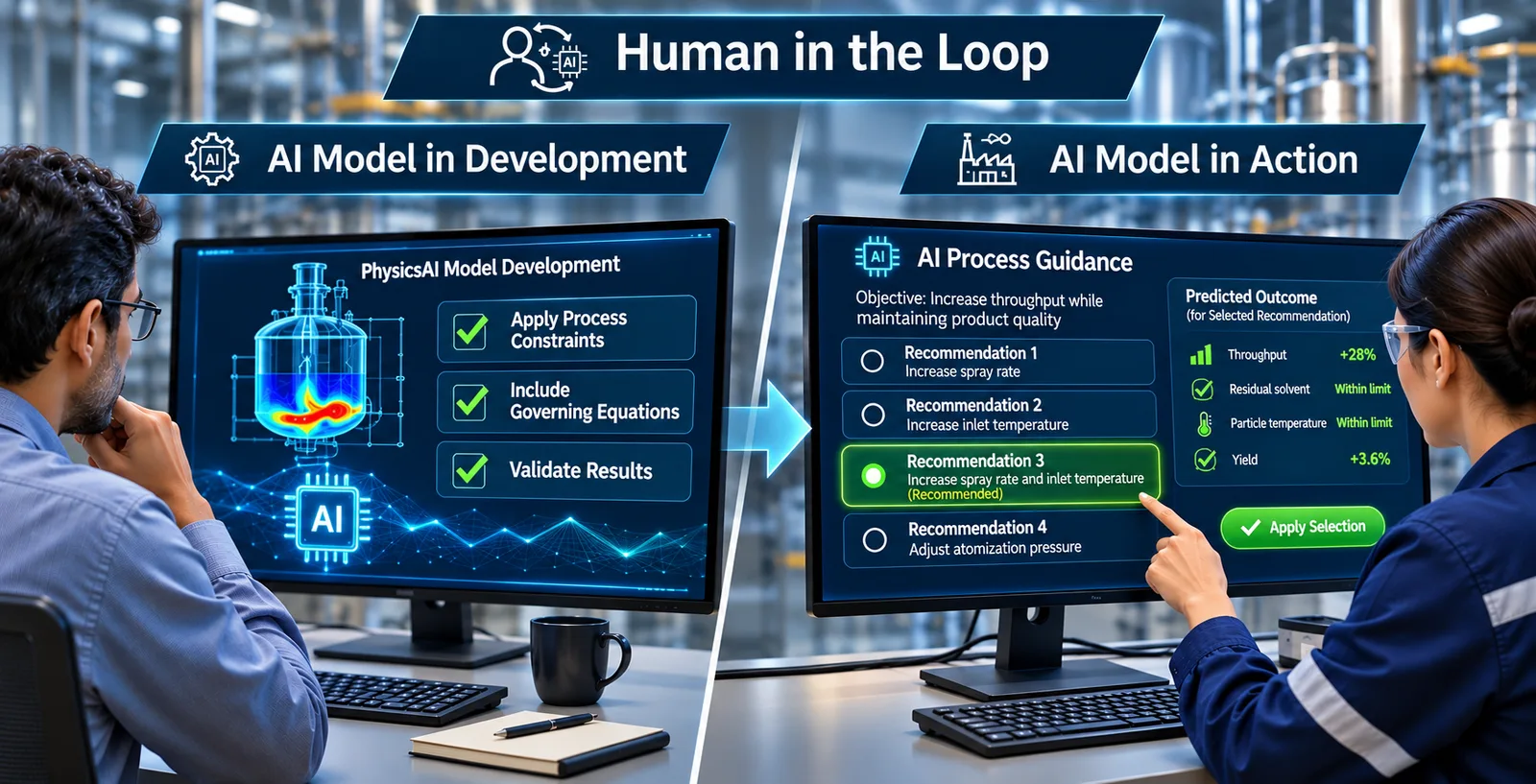
Human in the loop means engineers shape and
validate an AI model while it is being built, so
it earns their trust before it is ever used.
During development, domain engineers play a vital role in defining what the model must
deliver: its KPIs, the decisions it will support, and how it will be used. When that's clear
from the start, adoption becomes far easier.
This was an early lesson for us too. Early on, many conversations went like this: the model
isn't confident enough, so let's collect more data. More data sometimes helps, but it
doesn't fix unclear expectations. The industry has since run plenty of AI trials, some
successful and some not. The failures taught an important lesson: what to realistically
expect from AI.
Engineers also prepare and validate the data that goes into the model. But once a purely
data-driven model is trained, a domain engineer can only compare its predictions with
measured data. Whether they match or not, the engineer can't see why. The model remains a
black box.
This is where physics comes in. Physics-informed AI combines data with the laws of physics
and the constraints that govern a process, such as conservation of mass and energy. The
approach gained momentum with physics-informed neural networks, published in 2019, and our
team has worked with it since those early days, starting with classic problems such as
cantilever beams and flow through pipes. Because the model respects the laws of physics,
engineers find it easier to trust and adopt. This is the foundation of InteliSIM, our
PhysicsAI solution, which brings the laws of physics into AI through validated CFD
(computational fluid dynamics), DEM (discrete element method) and FEA (finite element
analysis) models.
Human in the loop: using the model
This is where setting the right expectations and
responsibilities becomes critical. When the
model is in use, the engineer stays at the center of decisions, and AI works inside their
workflow as an advisor, not a decision-maker. The model presents the possible options and
their pros and cons, backed by physics-based reasoning and data. The engineer owns the
accountability, and therefore makes the call.
What AI changes is how fast and how well-informed that call can be. A trained model has seen
far more scenarios than any person could review. When conditions shift, it can quickly
assess what's likely to happen, explain why based on physics, and lay out the options. Think
of it as a consultant: it does the heavy analysis, shows its reasoning, and leaves the
decision with you. The result is rapid, informed risk assessment. At Intelimek, these
lessons have shaped how we bring AI into engineering workflows. Rather than stopping at a
trained model or a prediction dashboard, we develop applications that let engineers explore
operating conditions, evaluate alternatives, understand potential risks, and make decisions.
This is how human-in-the-loop moves from a principle into everyday engineering
practice.
We were developing an AI model to predict accretion in rotary kilns used for sponge iron
production at a steel plant, and to recommend process changes to control it. The process
involved more than 100 parameters, and the model was built on more than five years of data.
A senior leader asked, quite reasonably, why it couldn't simply tell him which process
parameters to change. We explained that the model isn't there to replace the expert. It
shows the levers and the likely consequences of each, and the expert decides which one to
pull.
We've seen the same in food and pharmaceutical manufacturing. A food company needed to
decide what process changes were required after one ingredient in a food-mix powder changed.
A physics-based model let them evaluate the possibilities and make an informed decision. A
pharmaceutical customer needed to transfer a mixing process from one blender to another and
wanted insight into the optimal process parameters. Again, a physics-based model made that
possible, while the decisions stayed with their engineers.
These experiences reinforced an important lesson: a model's value is not established by
prediction accuracy alone, but by whether engineers can use its predictions to assess risks
and make practical decisions.
So, who makes the call?
The engineer makes the call. Good AI makes it
faster, better informed and easier to
defend.
We've worked with data-driven AI since 2016, across predictive maintenance, sensor
analytics, computer vision and physics-informed models. Along the way, we've learned where
human involvement matters, what engineers need to trust AI, and how to bring models into
their everyday workflows. These lessons have helped us move beyond developing AI models to
delivering applications that support real engineering decisions. AI that is never adopted
remains an academic exercise.
That's the principle behind how we build solutions at Intelimek: human in the loop, not just
during model development and validation, but also when AI is applied. The objective isn't to
replace engineering judgment. It's to give engineers the confidence, insights and tools to
make better decisions.
Frequently asked questions
Sources
- European
Commission, Industry 5.0
- European
Commission, Industrial Technologies Roadmap on Human-Centric Research and
Innovation for the Manufacturing Sector
- Cabinet
Office, Government of Japan, Society 5.0
- NIST, AI
Risk Management Framework
- Stanford
Institute for Human-Centered AI, About
- Raissi,
Perdikaris and Karniadakis, Physics-informed neural networks, Journal of
Computational Physics 378 (2019)
- European
Commission, Stakeholders' consultation on EU GMP Chapter 4, Annex 11 and new
Annex
22 (Artificial Intelligence)