Data center cooling has become one of the key factors influencing operating costs and energy consumption. With data-center capacity expanding rapidly across the US, EU and other regions, driven in part by AI and high-performance computing workloads, the need to manage cooling energy efficiently is becoming increasingly important. During the design phase, CFD is widely used to evaluate rack layouts, cooling air distribution, and operating conditions, helping engineers arrive at a robust design within the constraints of the building architecture.
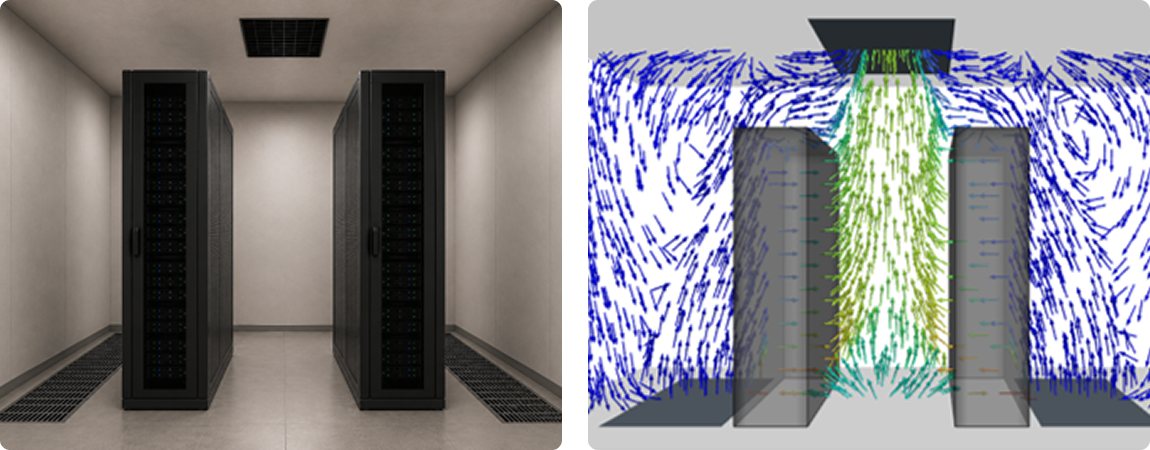
Once the data center is operational, the challenge changes. Heat loads vary continuously, and operators need to decide how much cooling air is required and what inlet temperature should be maintained to keep equipment within acceptable temperature limits while minimizing energy consumption. These decisions also influence broader energy-efficiency objectives such as Power Usage Effectiveness (PUE). Running a CFD simulation for every operating condition is not practical, particularly when a single CFD run can take hours.
This leads to an important question: can a PhysicsAI model trained on CFD data provide reliable temperature predictions for different operating conditions? The objective is not to replace CFD. CFD remains the source of engineering knowledge. The opportunity is to transform that knowledge into a model that can predict the temperature field in seconds, allowing different operating conditions to be evaluated without requiring a new CFD simulation each time. Such capability can support cooling optimization while helping operators work within applicable thermal guidelines and energy-efficiency objectives.
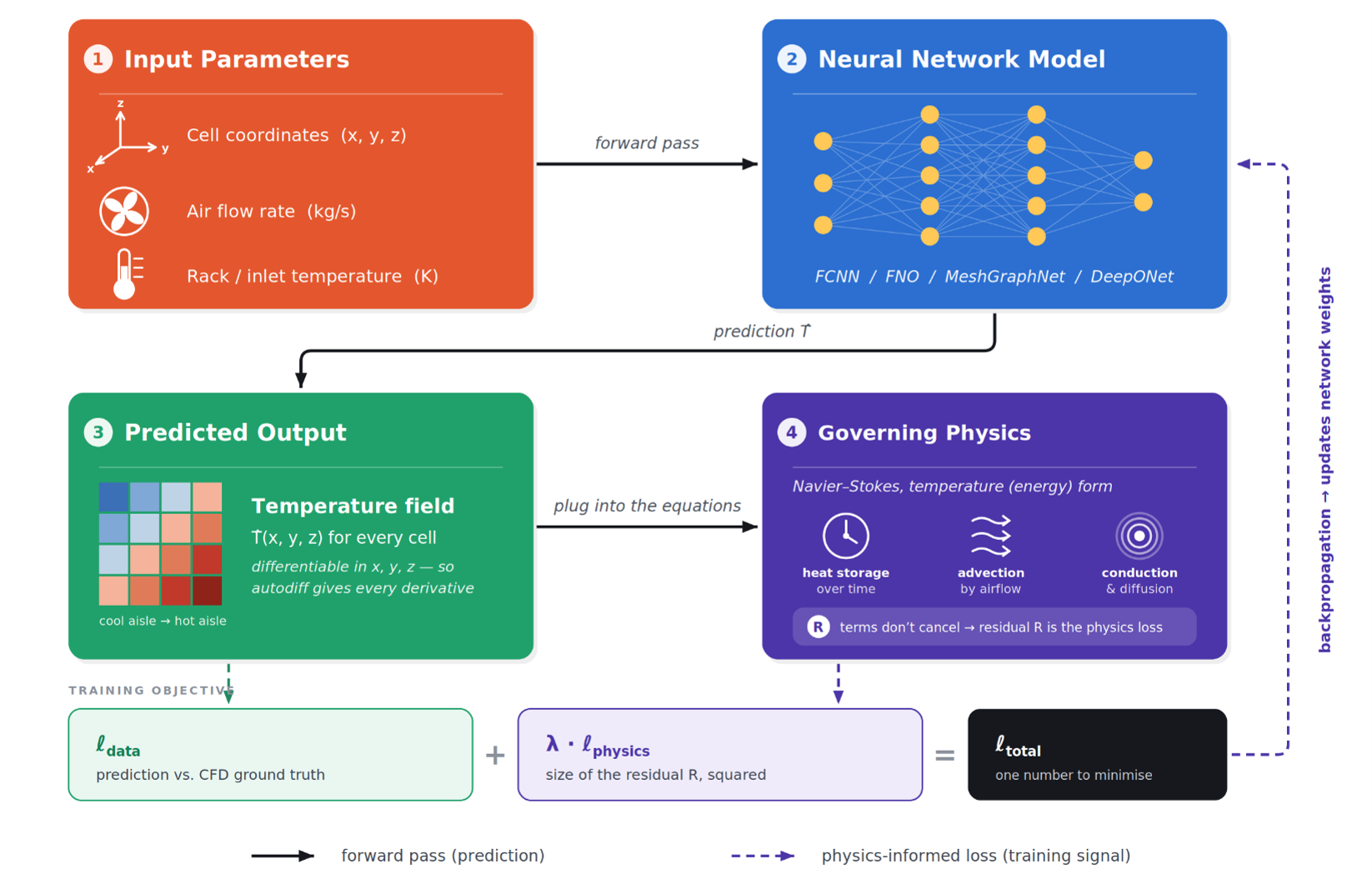
For this study, we used simulated CFD data from a data-center cooling case to train AI models for temperature-field prediction using NVIDIA PhysicsNeMo technologies. NVIDIA PhysicsNeMo provides PhysicsAI model architectures and workflows for learning from simulation and physics data. However, building a PhysicsAI model introduces another engineering question: which AI architecture is best suited to the problem? Different architectures represent spatial information differently, require different amounts of training data and hardware resources, and may behave differently when asked to predict a CFD case they have never seen.
We therefore trained and compared six network architectures using the same hardware and evaluated them with two different amounts of available CFD data. The comparison focuses not only on prediction accuracy, but also on training time, hardware usage, and performance on a full CFD case excluded from training. The results show that architecture selection is more nuanced than simply assuming that the largest or most complex network will perform best.
Dataset Information
The dataset is a Computing Rack Air Conditioning (CRAC) data-center cooling geometry, simulated 30 times across two operating parameters — air flow rate (5-10 kg/s) and CRAC supply temperature (288-294 K). The training was done on two different datasets created from the above data lake. The First one consisted of only 9 datasets with 6 for training, 2 for validation and 1 for testing. The second one consisted of all 30 datasets where 22 were used for training, 6 for validation and 2 for testing.
Base Network Building Architecture
The study evaluates multiple PhysicsAI architectures for predicting the complete temperature field within the data center. In addition to established architectures such as FCNN, FNO, and MeshGraphNet, an Intelimek Hybrid architecture combining FNO and FCNN was evaluated.
The motivation for the hybrid approach was to combine the complementary capabilities of the two architectures. While FNO provides a framework for learning spatial field relationships, FCNN provides an efficient approach for learning relationships between operating parameters and predicted quantities. The hybrid architecture integrates these capabilities within a single model for temperature-field prediction.
The results presented in the following sections compare the Intelimek Hybrid directly against the standalone FNO and FCNN approaches under the same training and validation conditions. This allows the benefit of the combined architecture to be assessed quantitatively rather than assumed.
Validation Approach
All architectures were evaluated against CFD using a stringent cell-by-cell comparison across the complete CFD mesh. Rather than comparing average temperatures, selected monitoring locations, or overall trends, the PhysicsAI-predicted temperature at every computational cell was compared directly with the corresponding CFD-predicted temperature.
For each cell, the prediction error was calculated as:
Cell-level error (%) = |PhysicsAI prediction − CFD prediction| / CFD prediction × 100
This provides a direct measure of how accurately each architecture reproduces the complete spatial temperature field. The resulting error field can also be visualized using error contours, showing both the magnitude and spatial distribution of deviations from the CFD solution.
This common validation approach was applied consistently across the architectures and datasets, enabling a direct comparison of model performance with limited training data (9 datasets) and with a larger training dataset (30 datasets).
The Six Network Architectures used here
| Architecture | Family | Core Idea |
|---|---|---|
| Base FCNN | Pointwise MLP | Constant-width dense network; every cell is an independent point. |
| Modified FCNN | Pointwise MLP | Same idea, individually-tuned hidden layer sizes. |
| FCNN + Fourier Features | Pointwise MLP | Coordinates pass through a random Fourier embedding before the MLP, so sharp local gradients are easier to fit. |
| DeepONet | Operator (branch/trunk) | Operating conditions and coordinates are encoded separately, then combined with a dot product. |
| FNO | Spectral operator | Mesh cells are flattened along a Morton curve and processed with learned convolutions in Fourier space. |
| MeshGraphNet | Graph neural network | Cells become nodes on a k-NN graph; message passing lets neighboring cells exchange information. |
Hardware cost to train each network
Hardware Specs used for Training the Networks
 CPU:
Intel i7 12700H (14 C | 20 T)
CPU:
Intel i7 12700H (14 C | 20 T)- RAM: 16
GB DDR5 4800 MHz
- GPU:
NVIDIA RTX 3060 6 GB VRAM
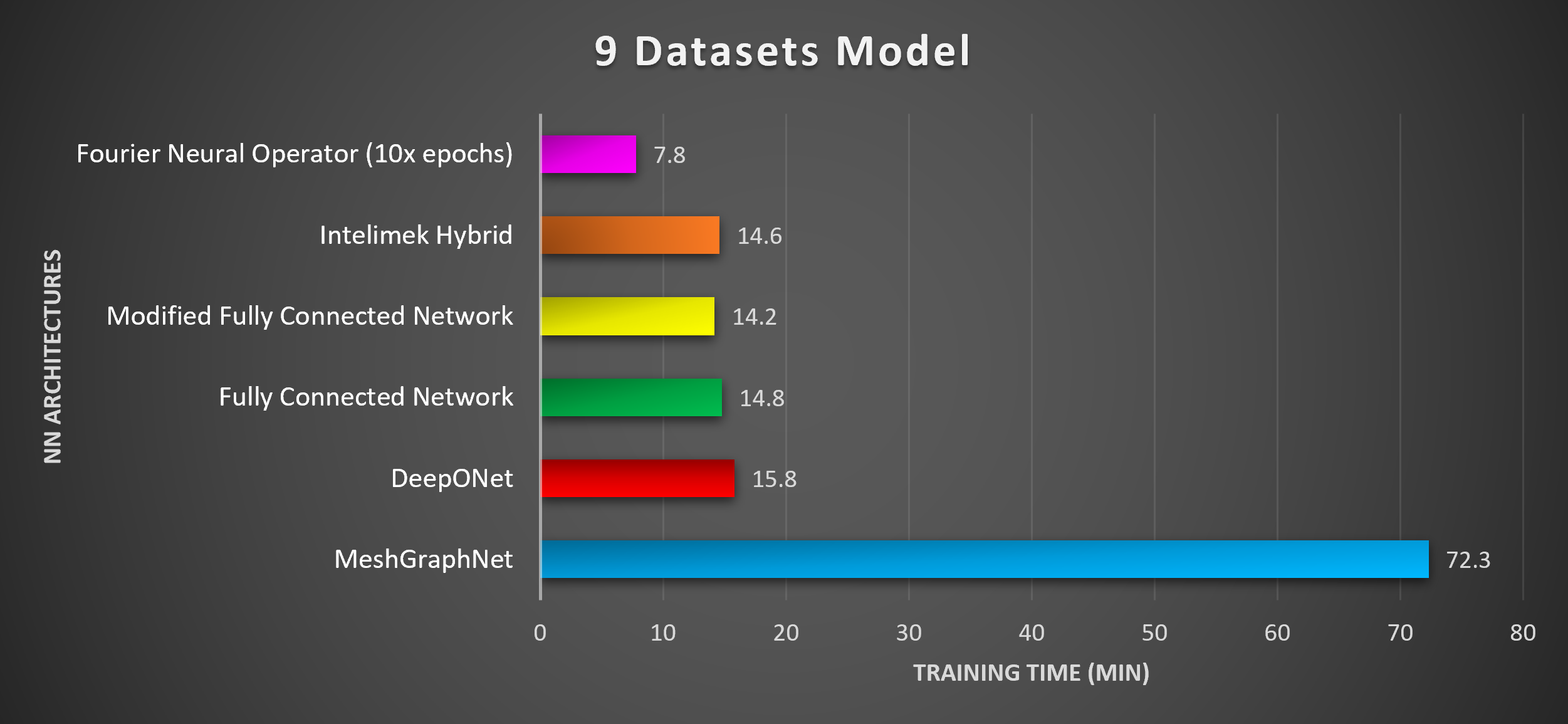
Time taken to train each network for the 9-Dataset Model
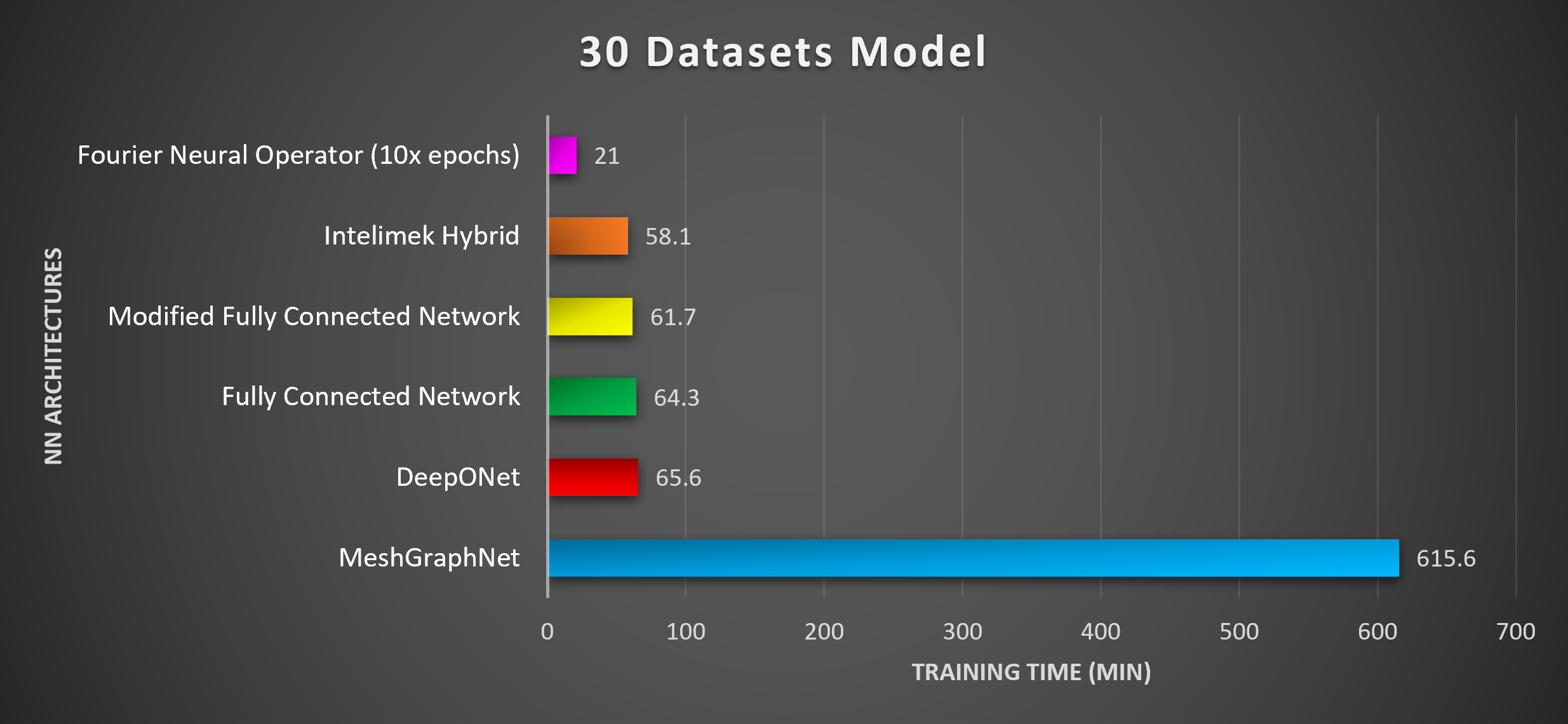
Time taken to train each network for the 30-Dataset Model
Hardware usage for 9-Dataset Model
| Model | Train Time | Peak VRAM | Epochs | Validation Accuracy |
|---|---|---|---|---|
| Base FCNN | 14.8 min | 0.16 GB | 50 | 0.810 |
| Modified FCNN | 14.2 min | 0.09 GB | 50 | 0.815 |
| Intelimek Hybrid | 14.6 min | 0.18 GB | 50 | 0.875 |
| DeepONet | 15.8 min | 0.30 GB | 50 | 0.768 |
| FNO | 7.8 min | 0.33 GB | 500 | 0.805 |
| MeshGraphNet | 72.3 min | 3.78 GB | 50 | 0.712 |
Hardware usage for 30-Dataset Model
| Model | Train time | Peak VRAM | Epochs | Validation Accuracy |
|---|---|---|---|---|
| Base FCNN | 64.3 min | 0.24 GB | 50 | 0.843 |
| Modified FCNN | 61.7 min | 0.14 GB | 50 | 0.972 |
| Intelimek Hybrid | 58.1 min | 0.25 GB | 50 | 0.941 |
| DeepONet | 65.6 min | 0.46 GB | 50 | 0.689 |
| FNO | 5.0 min | 0.55 GB | 500 | 0.818 |
| MeshGraphNet | 615.6 min | 4.89 GB | 50 | 0.977 |
Training Performance Observations
MeshGraphNet required substantially higher training time and peak VRAM than the other architectures in both dataset cases. This computational difference became particularly pronounced for the 30-dataset model.
The fully connected architectures and Intelimek Hybrid trained within a broadly similar time range on the same hardware, while maintaining comparatively low peak VRAM requirements.
FNO had the shortest reported training time, although it was trained for 10x epochs. These results highlight that architecture selection involves a trade-off between training time, hardware usage and model performance, which is evaluated separately on the unseen CFD case below.
The Real Exam: A Full CFD Case the Models Never Saw
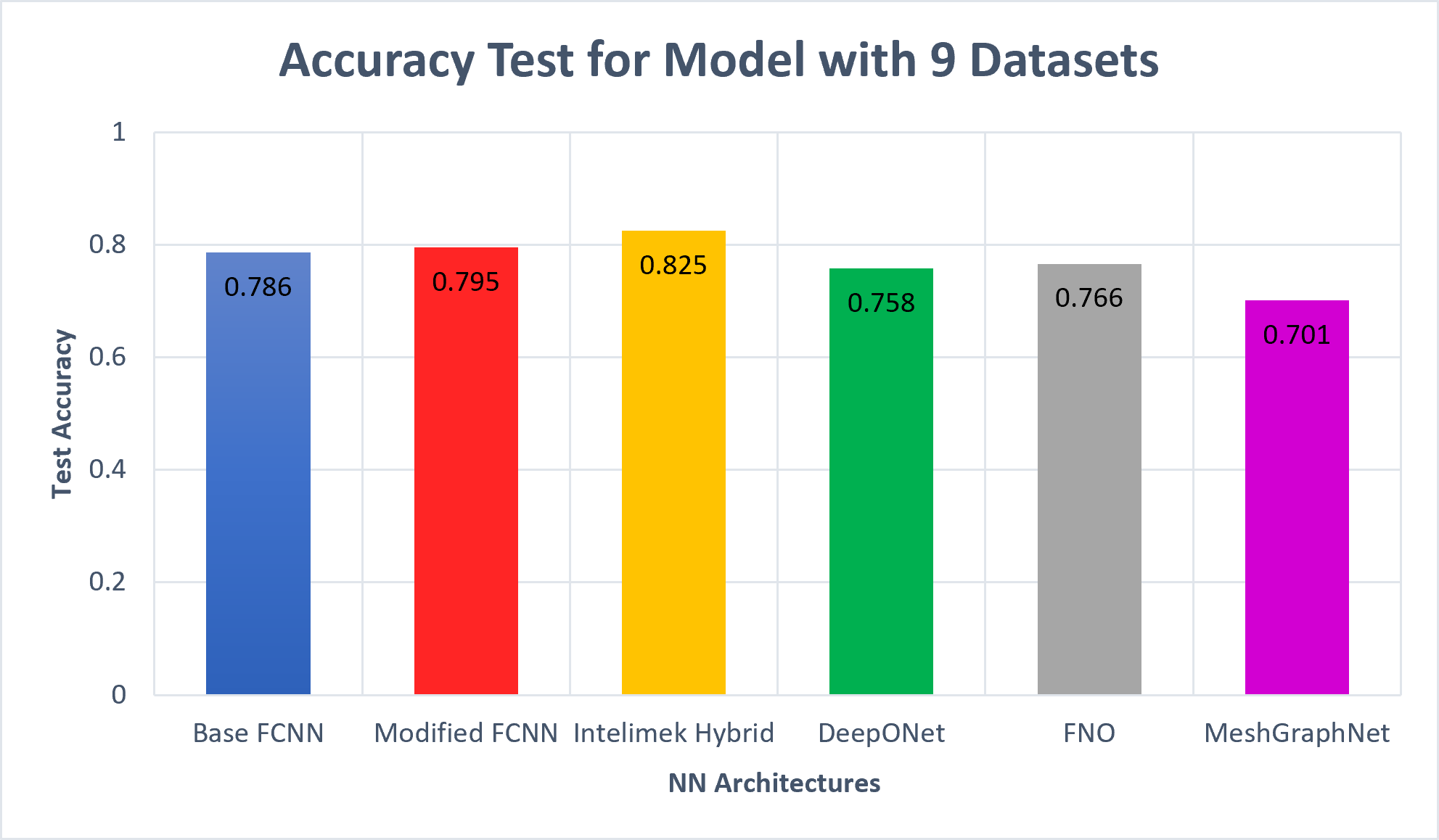
Test results for the 9-Dataset Model
| Model | Accuracy | Mean error % | % Cells <2% err | % Cells 2%-5% err | % Cells >5% err |
|---|---|---|---|---|---|
| Modified FCNN | 0.795 | 1.234 | 79 | 12 | 9 |
| MeshGraphNet | 0.701 | 2.148 | 70 | 22 | 8 |
| Intelimek Hybrid | 0.825 | 0.579 | 86 | 10 | 4 |
| Base FCNN | 0.786 | 1.403 | 76 | 14 | 10 |
| DeepONet | 0.758 | 1.812 | 73 | 18 | 9 |
| FNO | 0.766 | 1.528 | 77 | 10 | 13 |
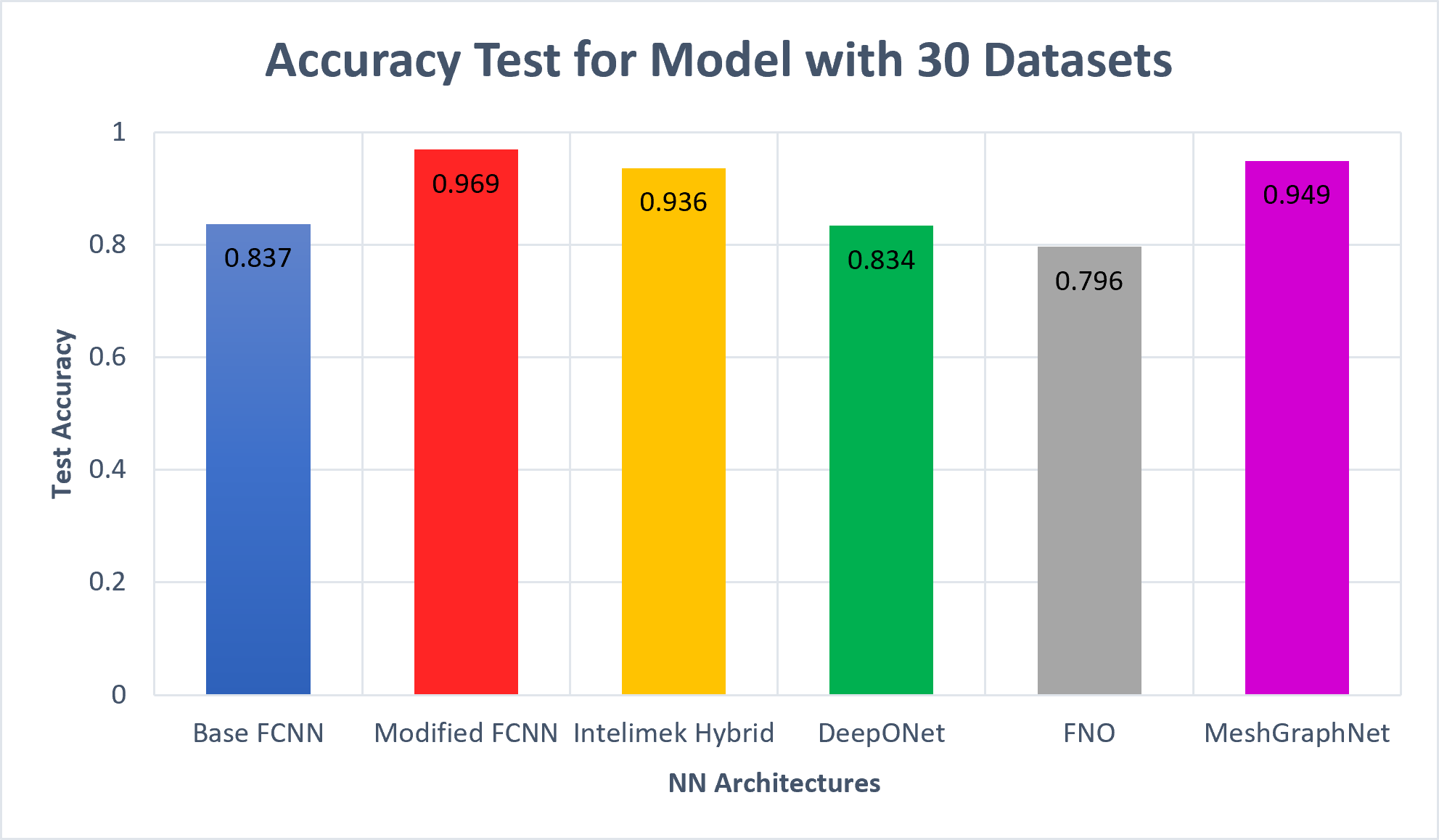
Test Results for the 30-Dataset Model
| Model | Accuracy | Mean error % | % Cells <2% err | % Cells 2%-5% err | % Cells >5% err |
|---|---|---|---|---|---|
| Modified FCNN | 0.969 | 0.159 | 97 | 3 | 0 |
| MeshGraphNet | 0.949 | 0.204 | 95 | 5 | 0 |
| Intelimek Hybrid | 0.936 | 0.231 | 94 | 6 | 0 |
| Base FCNN | 0.837 | 0.357 | 87 | 10 | 3 |
| DeepONet | 0.834 | 0.329 | 86 | 11 | 3 |
| FNO | 0.760 | 0.428 | 80 | 12 | 8 |
Observations
- MeshGraphNet showed relatively low
accuracy with the 9-dataset case. However, with more well-labelled training data
available in the 30-dataset case, its performance improved substantially, indicating the
data-intensive nature of this architecture.
- The standalone Fourier Neural
Operator (FNO) did not achieve comparable accuracy to the other architectures for this
case. However, when Fourier-based features were combined with the fully connected
architecture in the Intelimek Hybrid model, the resulting model achieved high accuracy
and consistent performance across both dataset sizes. This indicates the potential
benefit of combining complementary architectural approaches rather than relying on an
individual architecture.
- For the 30-dataset case, the
Modified Fully Connected Network achieved the highest test accuracy of 0.969,
demonstrating that a comparatively simpler architecture can perform very effectively
when sufficient training data is available.
- Intelimek Hybrid showed the most
consistent performance across the two dataset sizes, achieving a test accuracy of 0.825
with 9 datasets and 0.936 with 30 datasets, while maintaining relatively low training
time and hardware requirements.
Conclusion
The results demonstrate that there is no single architecture that is inherently best for every PhysicsAI problem. Model performance depends strongly on the amount of available training data, the representation of the underlying physics and geometry, and the computational resources required for training.
For this data center cooling case, the Modified FCNN achieved the highest accuracy when sufficient CFD data was available, while MeshGraphNet showed a significant improvement as the amount of training data increased. The Intelimek Hybrid architecture provided strong and consistent performance across both limited and larger datasets, demonstrating the potential of combining fully connected networks with Fourier-based features.
More importantly, the study demonstrates that CFD-generated knowledge can be learned by PhysicsAI models to predict temperature fields for previously unseen operating conditions. With appropriate architecture selection and sufficient validated CFD data, this approach holds strong promise for enabling rapid evaluation of cooling conditions and supporting the optimization of data center cooling without requiring a new CFD simulation for every operating condition.
As data centers continue to grow across the US, EU and other regions, rapid thermal prediction can become an important enabler for improving cooling energy efficiency and PUE while maintaining equipment within required operating conditions. Used within an engineering workflow, PhysicsAI can also support operators in working toward thermal and energy-efficiency requirements and guidance such as ASHRAE TC 9.9 Thermal Guidelines, ANSI/ASHRAE Standard 90.4 for data-center energy efficiency, and internationally recognized PUE measurement under ISO/IEC 30134-2.
The relevance is particularly strong as energy performance and sustainability expectations for data centers become more explicit globally. The EU, for example, has introduced energy-performance reporting obligations for data centers under the Energy Efficiency Directive, while the US is addressing rapidly growing data-center electricity demand through increased focus on energy management, grid reliability and efficiency. PhysicsAI does not itself establish compliance with these requirements, but it can provide a practical decision-support layer for evaluating cooling strategies quickly and making validated CFD knowledge available to operational teams.